


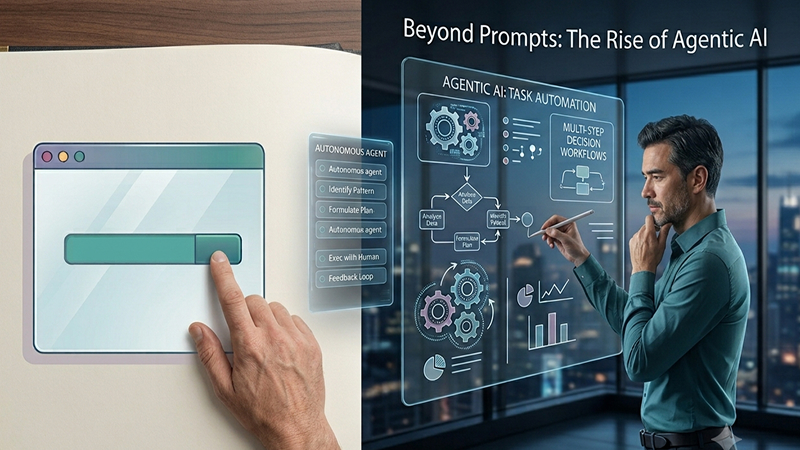
If you feel like you’ve finally mastered writing the perfect ChatGPT prompt, brace yourself: prompt engineering is already becoming obsolete. We are officially transitioning from the era of Generative AI (systems that respond to commands) to the era of Agentic AI—autonomous systems capable of setting their own goals, executing multi-step workflows, and solving complex problems without constant human intervention.
By next year, the tech world won’t be talking about chatbots. They will be talking about autonomous AI workloads and Enterprise AI agents. Here is what you need to know about the next massive wave in technology.
What is Agentic AI?
While traditional Large Language Models (LLMs) operate on a simple reactive framework (you give a prompt, it gives a response), Agentic AI architecture features memory, planning capability, and tool integration.
Instead of waiting for you to dictate every micro-step, an autonomous AI agent is given a high-level objective. For example: “Analyze our Q3 sales data, identify why customer churn increased in Europe, and draft a personalized email campaign targeting those specific users.” The agent then independently breaks this down into sub-tasks, queries databases, writes code, reviews its own work, and executes the solution.
Key Components of an AI Agent Workflow
- Contextual Memory: The ability to retain information across multiple sessions and tasks.
- Task Orchestration: Breaking massive, ambiguous goals down into structured, chronological pipelines.
- Tool Execution: The capacity to interact with external APIs, search the web, write to spreadsheets, and use software just like a human developer or marketer would.
Top Agentic AI Trends to Watch
As organizations move away from isolated proofs-of-concept, enterprise AI adoption is focusing heavily on ROI and infrastructure efficiency. Watch these three major shifts:
1. Modular AI Ecosystems
Instead of relying on one massive LLM to do everything, businesses are deploying networks of smaller, fine-tuned micro-agents. These agents collaborate via a decentralized architecture—one manages data fetching, another handles data analytics, and a third specializes in natural language generation.
2. Autonomous Network Management
In the IT and telecom sectors, agentic AI is moving into high-risk infrastructure. Next-generation networks are utilizing autonomous troubleshooting agents to predict server failures, reroute traffic, and patch security vulnerabilities in real-time, eliminating the need for human sysadmins to intervene.
3. Hyper-Personalized Digital Commerce Agents
Consumer tech is shifting toward “buyer agents.” Instead of browsing an e-commerce site, your personal AI agent will negotiate directly with a brand’s sales agent to secure you the best price on a flight or a subscription service based on your historical preferences.
How to Prepare for the Agentic Shift

Traditional AI: Human -> Prompt -> AI Model -> Output
Agentic AI:     Human -> Objective -> AI Agent -> Iterative Self-Correction -> Multi-Step Output
To stay competitive in this new landscape, developers, product managers, and tech leaders must pivot their strategies:
- Shift from Coding to Orchestration: The competitive edge is moving from manual coding to mastering AI agent governance. Understanding framework ecosystems like LangChain, CrewAI, and Microsoft AutoGen is becoming a core technical requirement.
- Prioritize Data Sovereignty: Because autonomous agents require access to internal databases to function effectively, businesses must design strict zero-trust architectures to prevent data leaks.
- Focus on Agent-to-Agent Security: As autonomous agents begin interacting with other companies’ agents, securing the APIs and protocols governing these interactions will become the next major frontier in cybersecurity.
The Bottom Line
The future of technology isn’t about how well you can talk to a machine; it’s about how well machines can work for you. Agentic AI is transforming software from a passive utility into an active, goal-oriented digital workforce. The businesses and developers who learn to orchestrate these autonomous agents today will be the ones leading the digital economy tomorrow.