


Artificial intelligence is moving into a new phase.
For years, people mostly interacted with AI through chatbots. You asked a question, and the chatbot gave you an answer. Today, however, a new type of AI is becoming increasingly important: AI agents.
The two terms are often used interchangeably, but they are not the same.
A simple way to remember the difference is:
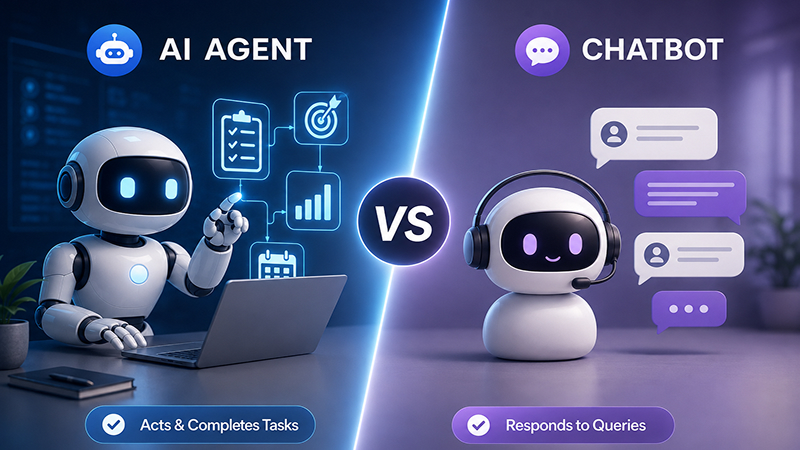
A chatbot mainly talks to you. An AI agent can work for you.
That difference may sound small, but it can completely change how businesses and individuals use AI.
What Is a Chatbot?
A chatbot is an AI-powered system designed primarily to communicate with people through conversation.
You send it a question or instruction, and it generates a response.
Modern AI chatbots can do much more than the old rule-based bots found on websites. They can write content, explain concepts, summarize documents, answer questions, brainstorm ideas, and help with many other tasks.
For example, you might ask a chatbot:
“Write a professional email asking my client to reschedule tomorrow’s meeting.”
The chatbot can generate the email for you.
But normally, you still have to take the next step: copy the email, open your email application, choose the recipient, and send it.
That’s where AI agents start to differ.
What Is an AI Agent?
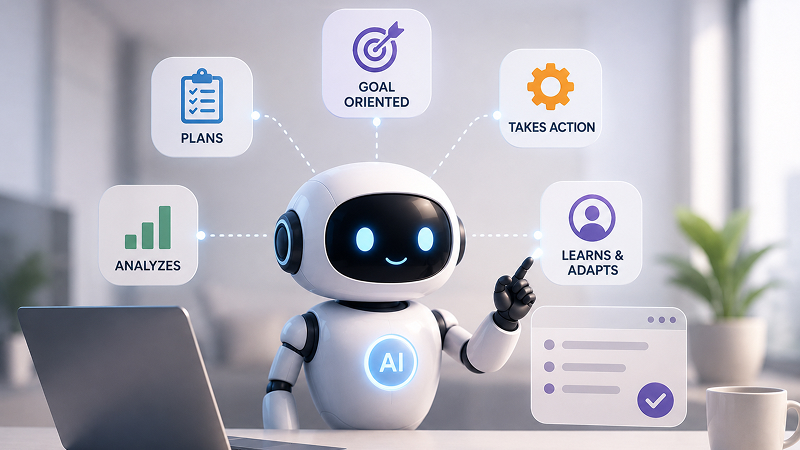
An AI agent is designed to accomplish a goal by taking multiple steps, using tools, making decisions, and potentially interacting with external systems.
According to OpenAI’s current explanation of agents, an agent can independently accomplish tasks on a user’s behalf and use tools to gather information or take actions in external systems. (OpenAI)
For example, instead of saying:
“Write an email to my client.”
You might tell an AI agent:
“Check my calendar, find another available time tomorrow, email the client, and update the meeting.”
An agent could potentially break this into several steps:
- Check your calendar.
- Find suitable times.
- Decide which option fits the instructions.
- Prepare the email.
- Send the message using an approved tool.
- Update the calendar.
- Tell you that the task is complete.
The important difference is action.
AI Agent vs Chatbot: The Main Difference
The biggest difference is autonomy.
A chatbot is primarily designed to respond to conversations.
An AI agent is designed to pursue a goal and complete a workflow.
| Feature | Chatbot | AI Agent |
|---|---|---|
| Main purpose | Conversation | Task completion |
| Answers questions | Yes | Yes |
| Generates content | Yes | Yes |
| Uses external tools | Sometimes | Often |
| Performs multiple steps | Limited | Yes |
| Makes decisions during a workflow | Limited | Yes |
| Can interact with external systems | Sometimes | Often |
| Works toward a defined goal | Usually limited | Yes |
| Level of autonomy | Lower | Higher |
However, this isn’t an absolute technical boundary. Modern products can combine a conversational interface with agent capabilities, so a system may look like a chatbot while functioning as an agent behind the scenes.
A Simple Real-World Example
Imagine you run an online store.
A customer asks:
“Where is my order?”
A chatbot might:
- Ask for the order number.
- Look up the order.
- Tell the customer its shipping status.
That’s useful, but the interaction mainly revolves around answering the question.
An AI agent might:
- Identify the customer’s order.
- Check the shipping system.
- Determine that the package is delayed.
- Check the company’s refund or replacement policy.
- Decide what action is permitted.
- Create a support ticket or initiate an approved replacement.
- Notify the customer.
- Update the company’s system.
The agent is not simply telling the customer what happened. It is potentially doing something about it.
That’s the fundamental shift.
How Do AI Agents Work?
Although implementations vary, an AI agent commonly combines three important components:
1. AI Model
The model provides the reasoning and language capabilities needed to understand instructions and decide what to do next.
2. Tools
Tools allow the agent to interact with external systems.
These could include:
- Web search
- Databases
- APIs
- Calendars
- Spreadsheets
- Software applications
- Code execution
- Company knowledge bases
OpenAI’s current agent documentation describes tools as a way for agents to fetch data, run code, call external APIs, and interact with computers. (OpenAI GitHub)
3. Instructions and Guardrails
An agent also needs rules describing what it is allowed to do.
For example:
“You can draft emails, but you must ask for approval before sending them.”
These restrictions are important because giving an AI the ability to take actions also introduces new risks.
Why Are AI Agents Becoming Popular Now?
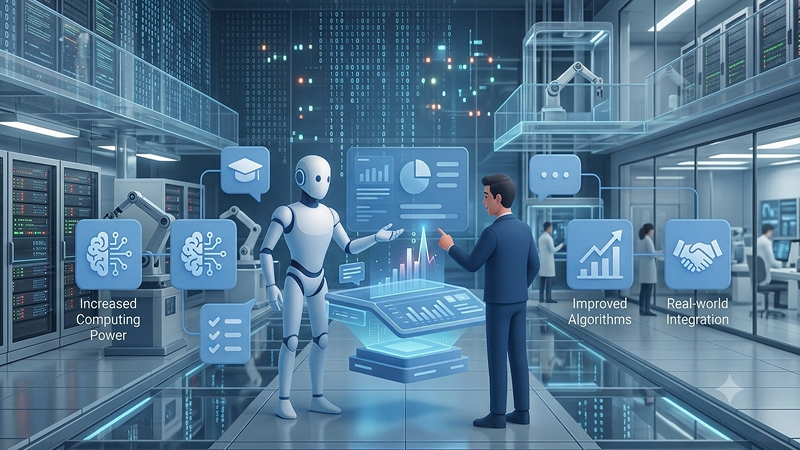
The technology behind AI agents isn’t completely new. What’s changing is the combination of more capable AI models, better tool integration, and improved AI infrastructure.
AI agents are increasingly being designed to work across multiple applications instead of remaining inside a single chat window.
For example, current AI agent systems can be connected to tools that allow them to search information, access files, execute code, or interact with external services. (OpenAI GitHub)
Major technology companies are also moving toward agentic experiences. Google announced new AI Search capabilities in 2026 that allow users to use agents through Search for more complex tasks. (blog.google)
This suggests that AI is gradually moving from:
Question → Answer
toward:
Goal → Plan → Actions → Result
Are AI Agents Better Than Chatbots?
Not necessarily.
It depends on what you need.
If someone visits your website and wants to know:
“What are your opening hours?”
A chatbot may be more than enough.
There is little reason to deploy a complicated autonomous agent just to answer a simple question.
But if the task is:
“Find my order, determine why it is delayed, check whether I qualify for a replacement, create the replacement order, and notify me.”
Then an agent may be much more appropriate.
The goal isn’t to replace every chatbot with an agent.
It’s to use the right level of automation for the task.
When Should You Use a Chatbot?
A chatbot can be a good choice when your main requirement is communication.
Common examples include:
- Frequently asked questions
- Product information
- Basic customer support
- Website assistance
- Simple troubleshooting
- Lead qualification
- Content generation
- General information
For straightforward conversations, a chatbot can be simpler, cheaper, and easier to control.
When Should You Use an AI Agent?
An AI agent becomes more useful when a task requires several steps or interactions with external systems.
Examples include:
- Researching information across multiple sources
- Managing repetitive business workflows
- Updating CRM records
- Processing customer requests
- Analyzing business data
- Scheduling tasks
- Handling software-development workflows
- Coordinating information between applications
OpenAI’s guidance similarly recommends agents for workflows where the system needs to interpret context, make decisions, and use tools to complete tasks. (OpenAI)
The Biggest Problem With AI Agents
More autonomy also means more responsibility.
A chatbot that gives you a bad answer is frustrating.
An agent that misunderstands your instruction and takes an incorrect action can create a much bigger problem.
Imagine an agent that:
- Sends an email to the wrong person
- Changes the wrong database record
- Purchases the wrong product
- Deletes information
- Shares confidential data
- Makes an incorrect business decision
This is why AI agents need permissions, monitoring, testing, and guardrails.
Current research and industry discussion around agents increasingly focuses not only on what they can accomplish, but also on how to keep their actions reliable and controlled. (WIRED)
Will Chatbots Disappear?
Probably not.
Chatbots and AI agents are likely to coexist.
In fact, the distinction may become less visible to ordinary users.
You might open a chat window and type:
“Help me plan my business trip.”
Behind that chat interface, an agent could search for information, compare options, access your calendar, and prepare a plan.
So the future may not be chatbot vs agent.
Instead, it could be:
Chat interface + AI agent + tools + human approval.
The user simply describes what they want, while the system handles the complicated work behind the scenes.
AI Agent vs Chatbot: The Easy Way to Remember
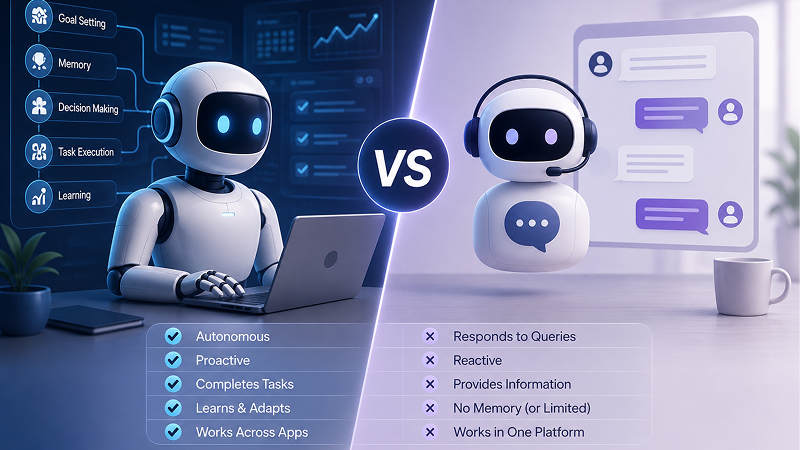
Here’s the simplest comparison:
Chatbot:
“Ask me something and I’ll answer.”
AI agent:
“Tell me what you want accomplished and I’ll work through the steps.”
A chatbot is primarily conversation-focused.
An agent is primarily goal-focused.
That doesn’t mean every chatbot is simple or every agent is fully autonomous. The technology exists on a spectrum, and many modern systems combine conversational AI with tools and agent-like workflows.
What Does the Future Look Like?
AI agents could become one of the most important developments in artificial intelligence because they change the role of AI from an assistant that provides information to a system that can execute work.
We’re already seeing this transition in areas such as search, software development, business workflows, and personal productivity. (blog.google)
The next major question isn’t simply:
“How smart is the AI?”
It is:
“What can the AI safely do for me?”
That may be the defining difference between the chatbot era and the emerging agent era.
Final Verdict
So, AI agent vs chatbot—which one is better?
Neither is automatically better.
Choose a chatbot when you mainly need conversation, answers, guidance, or content.
Choose an AI agent when you need the system to pursue a goal, use tools, make bounded decisions, and complete multiple steps.
And in many cases, the best solution may be both: a chatbot as the interface and an AI agent working behind it.
As AI continues to evolve, that combination could become increasingly common—and the distinction between “talking to AI” and “giving AI a job” may become one of the biggest changes in everyday computing.