


Technology has changed dramatically over the last few decades. Computers have become faster, smaller, and more powerful, while artificial intelligence is changing how we work and use digital tools.
But what if the next major change in computing comes from a completely different approach?
That is where quantum computing comes in.
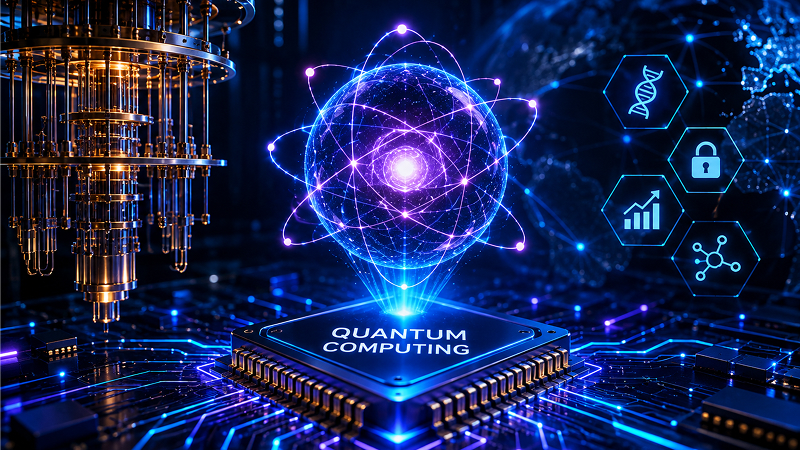
Quantum computing is an emerging technology that uses principles of quantum physics to process information differently from traditional computers. It has the potential to solve certain complex problems that are extremely difficult for classical computers.
The technology is still developing, but researchers and technology companies are working to make quantum computers more reliable, powerful, and practical.
From artificial intelligence and cybersecurity to healthcare, finance, drug discovery, and scientific research, quantum computing could influence many areas of technology.
So, what exactly is quantum computing, and why does it matter?
What Is Quantum Computing?
A traditional computer uses bits to process information. A bit can have a value of either 0 or 1.
Quantum computers use qubits, or quantum bits.
Qubits follow the rules of quantum mechanics and can exist in quantum states that allow information to be represented and manipulated differently from classical bits.
Three important concepts help explain how quantum computing works:
- Superposition
- Quantum entanglement
- Quantum interference
These properties allow quantum algorithms to approach certain problems in ways that traditional algorithms cannot easily reproduce.
However, quantum computers are not simply “faster computers.” They are specialized machines designed for specific types of computational problems.
How Does Quantum Computing Work?

Superposition
A classical bit is either 0 or 1.
A qubit can exist in a combination of quantum states before it is measured. This is called superposition.
Superposition gives quantum algorithms additional ways to represent and process information.
Quantum Entanglement
Quantum entanglement creates strong correlations between quantum particles or qubits.
When qubits are entangled, information about their states becomes connected in ways that do not have a direct classical equivalent.
Quantum Interference
Quantum algorithms use interference to increase the likelihood of useful results and reduce unwanted ones.
Together, these principles allow quantum computers to process certain problems using a fundamentally different approach.
Quantum Computing vs Traditional Computing
Traditional computers are not going away.
In fact, your smartphone, laptop, gaming console, and most business systems will continue to rely on classical computing.
Classical computers are excellent at general-purpose tasks such as:
- Browsing the internet
- Running applications
- Managing databases
- Streaming videos
- Gaming
- Business software
Quantum computers are being developed for more specialized problems, such as:
- Complex simulations
- Optimization
- Molecular modeling
- Cryptography
- Materials research
- Certain scientific calculations
The future is likely to involve classical and quantum computers working together, rather than one completely replacing the other.
Why Is Quantum Computing Important?
The biggest promise of quantum computing technology is its ability to approach certain complex problems differently.
Many real-world problems involve a huge number of possible combinations.
For example, a logistics company may need to find the most efficient way to deliver thousands of packages while considering routes, traffic, fuel, delivery times, and other conditions.
Quantum algorithms are being researched for certain optimization problems like these.
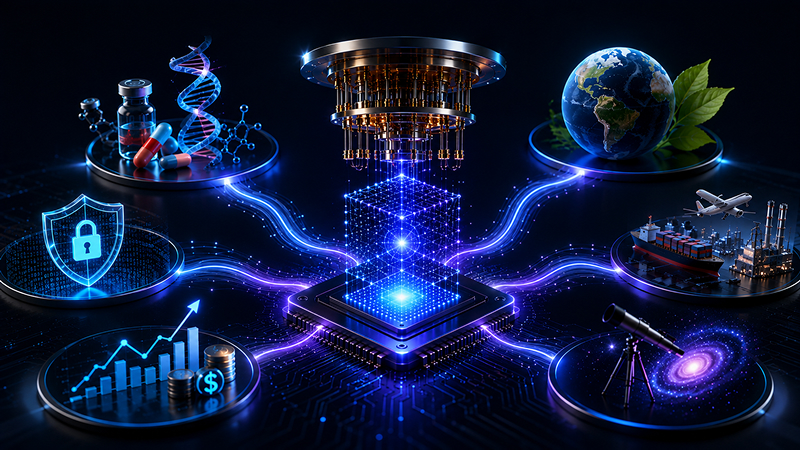
Potential quantum computing applications include:
- Healthcare
- Artificial intelligence
- Drug discovery
- Finance
- Cybersecurity
- Logistics
- Energy
- Materials science
- Scientific research
Not every problem will benefit from quantum computing. Its value will depend on finding situations where quantum methods can provide a meaningful advantage.
Quantum Computing and Artificial Intelligence
The combination of quantum computing and AI is one of the most interesting areas of research.
Modern AI systems require large amounts of computing power. Researchers are exploring whether quantum algorithms could eventually help with specific machine-learning, optimization, and data-processing problems.
Quantum computing is not expected to replace AI hardware such as GPUs.
Instead, quantum processors could become specialized tools that work alongside traditional computers and AI accelerators.
A future computing system could potentially combine:
Classical computers + AI hardware + quantum processors
Each technology would handle the tasks it is best suited for.
Quantum Computing in Healthcare
Healthcare could become one of the most valuable areas for quantum computing.
Developing new medicines requires scientists to understand complex chemical and biological interactions.
Quantum computers could eventually help researchers simulate molecules and chemical systems more effectively for certain problems.
This could support areas such as:
- Drug discovery
- Molecular research
- Medical research
- Chemical simulations
- Materials development
- Personalized medicine research
Quantum computers will not replace doctors or laboratory research. Instead, they could provide scientists with another powerful tool for exploring complex biological and chemical problems.
Quantum Computing and Cybersecurity
One of the biggest concerns surrounding the future of quantum computing is cybersecurity.
Many modern encryption systems depend on mathematical problems that are extremely difficult for traditional computers to solve.
A sufficiently powerful quantum computer could potentially threaten some existing cryptographic methods.
This is why researchers are developing post-quantum cryptography.
Post-quantum cryptography aims to create security methods that can protect digital information even in a future where powerful quantum computers exist.
This is important for banks, governments, businesses, healthcare organizations, and anyone handling sensitive information.
Quantum computing could therefore create new cybersecurity risks while also encouraging the development of stronger security technologies.
Quantum Computing in Finance
Financial institutions deal with complex calculations involving markets, risk, investments, and optimization.
Quantum computing could eventually support certain financial applications, including:
- Portfolio optimization
- Risk analysis
- Financial modeling
- Market simulations
- Complex optimization
These applications are still being researched, but finance is considered an interesting area for exploring the potential of quantum technology.
What Are the Challenges of Quantum Computing?
Quantum computing has huge potential, but there are also major challenges.
One of the biggest is quantum error.
Qubits are extremely sensitive to their surroundings. Small disturbances can affect their state and cause errors.
Researchers are working on quantum error correction, better hardware, improved control systems, and more reliable quantum processors.
Other challenges include:
- High technical complexity
- Expensive hardware
- Difficult scalability
- Limited practical applications
- Complex programming
- Error correction requirements
Because of these challenges, useful large-scale quantum computing will require continued research and development.
Will Quantum Computers Replace Normal Computers?
No.
This is one of the biggest misconceptions about quantum computing.
Quantum computers are not designed to replace smartphones, laptops, or everyday computers.
Instead, they are more likely to become specialized computing systems.
Think of a quantum computer as another tool in the computing ecosystem.
Traditional computers will continue handling everyday tasks, while quantum computers could eventually handle certain problems where quantum algorithms offer an advantage.
What Is the Future of Quantum Computing?
The future of quantum computing will depend on how successfully researchers solve the technology’s current challenges.
If quantum computers become more reliable and scalable, they could become an important part of the computing infrastructure.
Businesses may access quantum processors through cloud platforms instead of owning physical machines.
Scientists could use quantum computers to explore new materials and chemical systems.
Developers could create applications designed specifically for quantum processors.
Cybersecurity teams could prepare systems for a post-quantum world.
The biggest impact may happen behind the scenes rather than through a product that consumers directly purchase.
Final Thoughts
Quantum computing is more than just another type of computer.
It represents a new approach to processing information and could eventually help solve problems that are extremely difficult for traditional systems.
Its potential applications range from AI and cybersecurity to healthcare, drug discovery, finance, materials science, and scientific research.
There are still significant technical challenges, and many proposed applications need to prove their value in real-world situations.
But that is what makes quantum computing such an important emerging technology to watch.
The future of computing may not belong to classical computers or quantum computers alone.
Instead, it could belong to a world where classical computing, artificial intelligence, and quantum technology work together to solve problems that were previously beyond our reach.