


Zero-Click AI Search: Why Users May Stop Visiting Websites
For years, the basic idea of Google Search was simple: type a question, scan the results, click a website, and find the answer.
That behavior is changing.
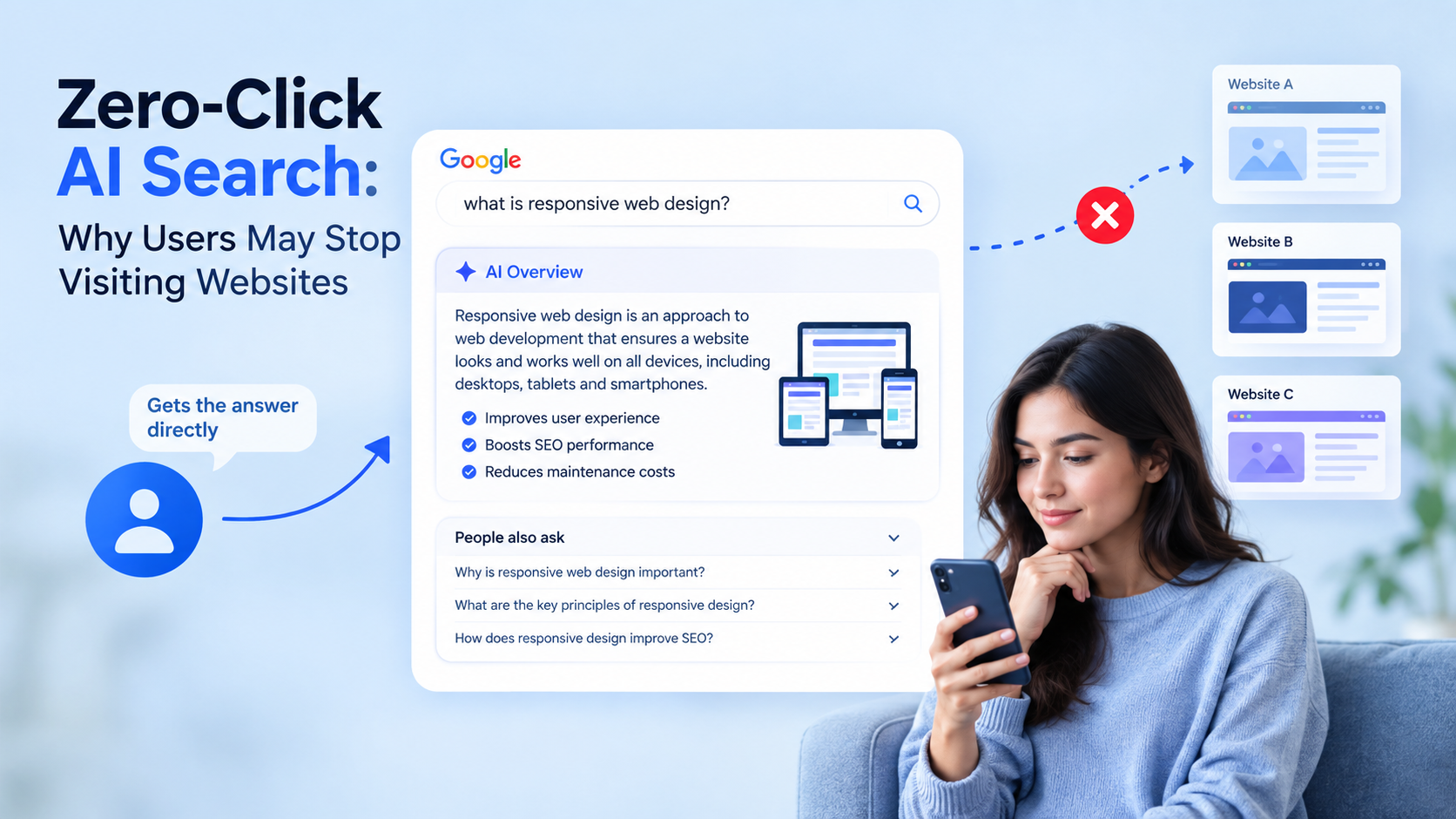
With the rise of AI search, users can increasingly get direct answers without opening a traditional search result. Google’s AI Overviews and AI Mode can summarize information, compare options, answer follow-up questions, and help users explore complex topics directly inside Search.
This shift is giving rise to an important SEO concept: zero-click AI search.
But does this mean people will stop visiting websites completely? Not necessarily. The bigger change may be why people visit websites and what kind of content earns those visits.
What Is Zero-Click AI Search?
A zero-click search happens when a user gets the information they need directly from a search results page without clicking through to another website.
This isn’t entirely new. Featured snippets, knowledge panels, weather information, maps, calculators, and other Google search features have already answered many queries without requiring a website visit.
AI search takes this idea further.
Instead of simply displaying a short answer, generative AI can combine information from multiple sources and provide a conversational response. Users can then ask follow-up questions without starting a completely new search.
This makes searching faster, but it also creates a challenge for website owners: if the answer is already visible on Google, what reason does a user have to click?
Why AI Search Could Reduce Website Clicks
The biggest risk is with searches that have simple and predictable answers.
For example, someone searching for:
- “What is responsive web design?”
- “How many calories are in an apple?”
- “What is the capital of France?”
- “What does SEO mean?”
may not need to visit a website if an AI-generated answer provides enough information immediately.
The user gets the answer, closes the search, and moves on.
This is the core concern behind zero-click AI search: informational content that once attracted website traffic may increasingly be consumed directly within search results.
However, this doesn’t mean every type of website traffic will disappear.
People Still Click When They Want More
A quick answer is useful, but it isn’t always enough.
Imagine someone searching for “best laptop for graphic design.” A short AI summary may help them understand their options, but they may still want detailed reviews, benchmark results, comparisons, real photographs, pricing, user experiences, or expert opinions before buying.
The same applies to complex topics.
People often visit websites when they want:
- Detailed explanations
- Original research
- Product reviews
- Expert opinions
- First-hand experiences
- Tutorials and guides
- Case studies
- Videos and visual content
- Tools and calculators
- Products or services
- Information from a trusted brand
This creates an important distinction: AI search may reduce some low-value clicks while increasing the importance of valuable clicks.
Google itself says that AI features continue to provide links to websites and that clicks from AI search can be higher quality. Google has also stated that overall organic click volume has remained relatively stable in its reported data, while acknowledging that traffic patterns are changing between different types of websites.
What Does This Mean for SEO?
It doesn’t mean SEO is dead.
In fact, Google says that traditional SEO fundamentals remain relevant for AI Overviews and AI Mode. Websites still need to be crawlable, indexable, technically sound, useful, and focused on people-first content.
But SEO in the age of AI is becoming less about simply getting a user to click and more about becoming a useful source that AI search systems can understand, reference, and recommend.
That means creating content that offers something beyond a basic definition.
Instead of writing:
“What is SEO?”
and providing a generic 500-word explanation, a stronger approach could be:
“How We Improved a Website’s SEO: A Real Before-and-After Case Study”
The second topic contains experience, evidence, examples, and information that is harder to replace with a generic AI-generated answer.
Original Content Will Become More Important
As AI-generated content becomes easier to produce, the internet could become filled with articles saying essentially the same thing.
This creates a new opportunity for websites that publish original content.
Google’s guidance for AI search emphasizes unique, valuable, non-commodity content rather than content created simply to manipulate rankings.
For publishers and businesses, this could mean investing more in:
- Original research
- Industry data
- Expert interviews
- Case studies
- Personal experiences
- Product testing
- Unique analysis
- Original images and videos
- Practical examples
In other words, don’t just repeat what is already available. Give people a reason to visit your website.
AI Search Is Changing Search Intent
Another major change is how people search.
Google reports that AI Mode users are asking longer and more complex questions, while AI-powered Search is generating new types of queries.
Instead of searching:
“website design trends”
a user might ask:
“What website design trends should a small business use in 2027 to improve conversions?”
This creates opportunities for websites that understand search intent rather than simply targeting individual keywords.
Your content should answer the complete problem behind the search.
How Websites Can Prepare for Zero-Click AI Search
Website owners don’t need to abandon traditional SEO. Instead, they need to make their content more useful.
1. Answer the basic question quickly
Give users a clear answer near the beginning of your article.
2. Go deeper than the basic answer
Add examples, research, experience, comparisons, and practical advice that users can’t get from a one-paragraph summary.
3. Build topical authority
Create a collection of useful content around your subject instead of publishing disconnected articles targeting random keywords.
4. Create content people want to explore
Reviews, case studies, original research, tutorials, tools, and visual content can give users a reason to leave the search results.
5. Focus on brand trust
When users recognize and trust a brand, they are more likely to search for it directly, visit its website, and engage with its content.
6. Measure more than clicks
Clicks are important, but businesses should also look at conversions, leads, sales, engagement, and returning visitors.
Google has also introduced dedicated Search Console reporting for visibility from generative AI features, giving website owners more ways to understand how their content appears in AI-powered Search.
Will Users Really Stop Visiting Websites?
Probably not.
The more realistic future is that users will become more selective about which websites they visit.
For simple questions, an AI-generated answer may be enough. For complex decisions, purchases, research, opinions, experiences, and detailed information, people can still have strong reasons to visit the original source.
The bigger shift is that websites can no longer depend entirely on providing information that AI can summarize in a few sentences.
The websites that stand out will provide something more: experience, originality, trust, depth, tools, products, communities, or perspectives.
The Future of Search Is Not Just About Getting the Click
Zero-click AI search is changing the relationship between Google, users, and websites.
Search engines are becoming answer engines, while users are becoming more comfortable getting information without immediately opening a website.
But that doesn’t make websites irrelevant.
It changes what makes a website worth visiting.
The future of SEO may not be about fighting against zero-click searches. It may be about creating content that makes users think:
“The AI gave me the answer. Now I want to see the source.”
That is where AI search optimization, strong SEO fundamentals, original content, and genuine user value will become increasingly important.