



Search is changing.
For years, businesses focused on one question: How do I rank higher on Google?
Today, there is another question businesses need to ask:
How do I make sure my brand is visible when people ask AI search engines for recommendations, answers, and solutions?
Google AI Overviews, AI Mode, ChatGPT, Gemini, and other AI-powered search experiences are changing how people discover information online. Instead of scanning ten blue links, users can increasingly receive a direct, summarized answer generated from multiple sources.
That creates a new digital marketing challenge—and opportunity.
Your website may rank well in traditional search but still receive little visibility inside AI-generated answers. Conversely, a brand with strong expertise, useful content, credible mentions, and a technically sound website can become a source that AI systems use when generating answers.
This is where AI search optimization, Answer Engine Optimization (AEO), and Generative Engine Optimization (GEO) become important.
In this guide, we’ll explain what they mean, how they differ from traditional SEO, and what businesses can do now to improve their visibility in AI search.
What Is AI Search Optimization?
AI search optimization is the process of improving a brand’s website, content, reputation, and online presence so that AI-powered search systems can better understand, trust, retrieve, and potentially reference the brand.
Traditional SEO primarily focuses on helping search engines understand and rank webpages.
AI search optimization goes one step further.
It considers how information can be:
- Discovered by AI systems
- Understood accurately
- Connected with a specific brand or entity
- Retrieved for relevant questions
- Supported by credible sources
- Used in AI-generated responses
The goal isn’t simply to replace SEO.
Instead, businesses need to build on traditional SEO and make their digital presence useful for both search engines and AI-powered discovery systems.
Why AI Search Visibility Matters in 2026
AI is becoming an increasingly important layer between users and the websites they eventually discover.
Google has continued expanding AI-generated search experiences, including AI Overviews and AI Mode. Recent changes have even made AI-generated summaries more prominent in some searches, pushing traditional organic listings further down the page.
At the same time, businesses are beginning to track a new form of visibility: whether their brands appear in answers generated by AI platforms.
This means that traditional metrics such as rankings and clicks are no longer the only indicators worth watching.
Businesses should increasingly ask:
Does AI know our brand?
Does it understand what we do?
Does it associate our brand with the right services and expertise?
Does it find our content when answering relevant questions?
These questions form the foundation of AI search visibility.
SEO vs AEO vs GEO: What’s the Difference?
The terminology can be confusing because SEO, AEO, and GEO overlap.
Here’s a simple way to understand them.
SEO — Search Engine Optimization
SEO focuses on improving visibility in traditional search engines.
Common activities include:
- Keyword research
- Technical SEO
- On-page optimization
- Internal linking
- Backlink building
- Content optimization
- Page speed improvements
- Structured data
The objective is to help pages rank for relevant searches.
AEO — Answer Engine Optimization
Answer Engine Optimization focuses on making content useful for systems that provide direct answers.
Instead of only targeting:
“digital marketing agency”
you may also create content answering questions such as:
“What does a digital marketing agency do?”
“How much does SEO cost for a small business?”
“What is the difference between SEO and AEO?”
Clear questions, direct answers, structured information, and helpful explanations become particularly important.
GEO — Generative Engine Optimization
Generative Engine Optimization focuses on increasing the likelihood that content or information about a brand is surfaced, referenced, or cited in generative AI experiences.
GEO can involve:
- Creating authoritative content
- Establishing topical expertise
- Building credible third-party mentions
- Improving entity clarity
- Providing original insights and data
- Structuring content clearly
- Maintaining accurate business information
- Strengthening digital reputation
Research into generative search is also examining how GEO can influence which sources are retrieved and cited by generative systems.
The Bigger Picture
Rather than treating these as three completely separate strategies, businesses should think of them as connected layers:
SEO → AEO → GEO → AI Visibility
Strong SEO provides the technical and content foundation.
AEO makes information easier to use as answers.
GEO helps strengthen visibility within generative search experiences.
Together, they create a more complete search strategy.
How to Get Your Brand Mentioned in AI Search
There is no guaranteed formula for making an AI platform mention a particular company.
However, businesses can improve their chances by making their information easy to discover, understand, verify, and associate with the correct entity.
Here are seven practical strategies.
1. Build Topical Authority Instead of Publishing Random Articles
One of the biggest mistakes businesses make with content marketing is publishing unrelated articles simply because a keyword appears to have search volume.
AI search makes topical depth even more important.
Suppose your company provides website design.
Instead of publishing five generic articles about websites, build a content ecosystem around the subject.
For example:
Website Design
→ Website UX
→ Responsive Web Design
→ Website Accessibility
→ Website Performance
→ Website Conversion Optimization
→ WordPress Website Design
→ Webflow Development
→ Website SEO
→ Website Redesign
→ Website Maintenance
This creates a much stronger topical footprint.
Your website isn’t simply saying:
“We design websites.”
It is demonstrating:
“We understand website design from multiple perspectives.”
That distinction can strengthen your overall digital authority.
2. Answer Specific Questions Clearly
AI systems need information they can understand and retrieve.
Make your content easy to extract without making it robotic.
For example, instead of beginning an article with several paragraphs of generic introduction, answer the core question early.
What is AI search optimization?
AI search optimization is the process of improving a brand’s online presence so AI-powered search systems can better understand, retrieve, and potentially reference its content and information.
Then explain the subject in greater depth.
This structure benefits users while also making important information easier to identify.
Useful formats include:
- Question-and-answer sections
- Definitions
- Step-by-step guides
- Comparison tables
- Bullet lists
- FAQs
- Examples
- Original research
- Expert explanations
3. Make Your Brand Entity Crystal Clear
AI systems need to understand who you are and what your business does.
Your website should consistently communicate:
- Brand name
- Services
- Industry
- Location
- Areas served
- Expertise
- Team information
- Contact information
- Company history
- Relevant clients or industries
- Social profiles
- Author information
Avoid creating contradictory information across different platforms.
If one website describes your business as a “branding agency,” another calls you a “web development company,” and another says you’re a “digital marketing consultant,” AI systems may have a harder time establishing a consistent understanding of your brand.
Your digital identity should tell one coherent story.
4. Don’t Ignore Third-Party Mentions
Your own website isn’t the only source AI systems can use.
Brand information can exist across:
- Industry publications
- News websites
- Business directories
- Review platforms
- Interviews
- Podcasts
- Guest articles
- Partner websites
- Case studies
- Professional communities
Recent discussion around AI visibility has highlighted the growing importance of earned media and third-party references in how brands are represented by AI systems.
This means digital PR and SEO are becoming increasingly interconnected.
A business doesn’t only need to say:
“We’re experts.”
It needs credible signals across the web that support that claim.
5. Create Original Information
Generic content is easy to reproduce.
Original information is much more valuable.
Consider publishing:
- Original research
- Surveys
- Industry statistics
- Case studies
- Experiments
- Customer insights
- Before-and-after results
- Expert opinions
- Unique frameworks
- Proprietary data
For example, instead of writing:
“Website speed is important.”
you could publish:
“We analyzed 50 small-business websites and found these five recurring performance problems.”
Now you’ve created something other websites can reference.
That can lead to citations, backlinks, mentions, and stronger authority.
6. Improve Your Website’s Technical Foundation
AI visibility isn’t only about writing better blog posts.
Your website needs to be technically accessible and understandable.
Pay attention to:
Website speed
Slow websites can create poor user experiences and may make it harder for systems to efficiently access content.
Mobile experience
Your website should work properly across mobile devices.
Internal linking
Connect related pages so users and search systems can understand relationships between topics.
Structured data
Use appropriate structured data where relevant to help search engines understand entities, organizations, products, articles, and other content types.
Clean information architecture
Important content shouldn’t be buried beneath unnecessary layers.
Crawlability
Search engines and other systems need to be able to access important pages.
Website performance is becoming an increasingly important part of AI search visibility because AI systems still need accessible, understandable web content to retrieve and interpret information.
7. Build Content for Humans First
There’s an important warning here.
Don’t turn your website into a collection of pages written exclusively for AI systems.
AI search optimization should not mean:
- Keyword stuffing
- Repeating the same phrase dozens of times
- Publishing hundreds of low-quality AI-generated articles
- Creating fake expertise
- Manipulating citations
- Writing unnatural content
Search systems and AI systems are increasingly sophisticated.
More importantly, your ultimate audience is still human.
The best strategy is simple:
Create genuinely useful information that happens to be easy for machines to understand.
What Makes Content More “Citation-Worthy”?
If your goal is to improve AI search visibility, ask whether another website, journalist, researcher, or AI system would have a reason to reference your content.
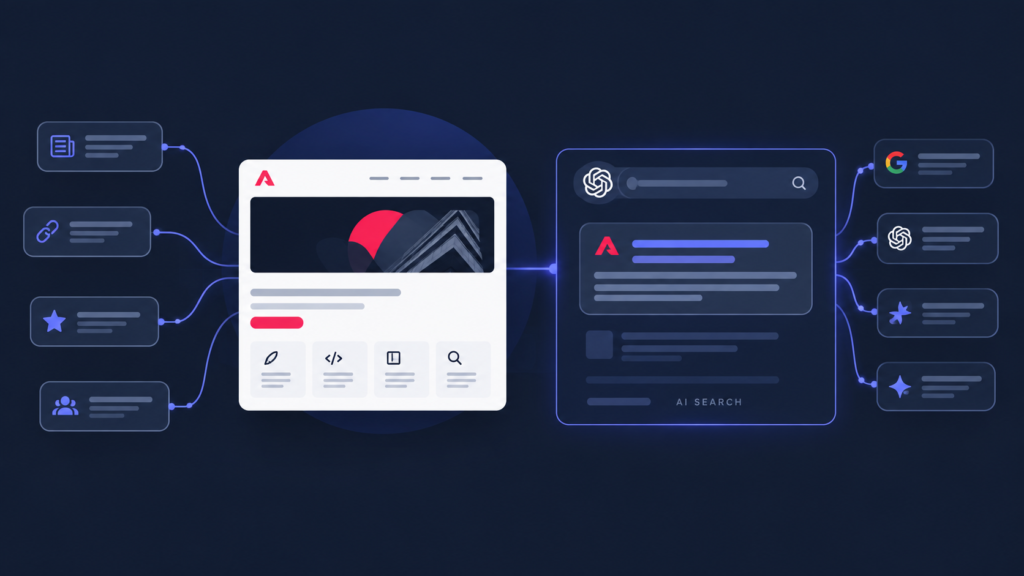
Citation-worthy content usually contains one or more of these qualities:
Original
It provides information that isn’t simply copied from ten other websites.
Specific
It answers a clearly defined question.
Credible
It demonstrates expertise and uses trustworthy sources where appropriate.
Useful
It helps the reader solve a real problem.
Well-structured
The information is organized logically.
Updated
Important information isn’t obviously outdated.
Verifiable
Claims can be supported or checked.
This is far more sustainable than trying to find a single “GEO trick.”
Does GEO Replace SEO?
No.
SEO isn’t dead.
In fact, technical SEO, content quality, links, site architecture, authority, and user experience remain important foundations for digital visibility.
What’s changing is the way people consume search results.
A traditional search journey might look like:
Query → Google → Search Results → Website → Answer
An AI-assisted journey can look more like:
Question → AI Search → Synthesized Answer → Selected Sources → Website
That changes the visibility equation.
Your website still needs to be discoverable, but now there is another layer between your content and the user.
How Businesses Should Measure AI Search Visibility
Traditional SEO reporting often focuses on:
- Organic traffic
- Rankings
- Click-through rate
- Backlinks
- Conversions
These metrics should remain part of the picture.
But businesses can also begin monitoring:
- Brand mentions in AI answers
- Citation frequency
- Which questions trigger brand mentions
- Competitors appearing in AI answers
- Accuracy of AI-generated brand information
- Referral traffic from AI platforms
- Branded search growth
- Third-party mentions
- Content being referenced by other websites
AI visibility is still an evolving measurement category, so businesses should avoid treating any single third-party “AI ranking score” as a definitive measure of success.
Instead, look for trends across multiple signals.
A Practical AI Search Optimization Checklist
Before publishing your next piece of content, ask:
Content
- Does this answer a real question?
- Does it provide something genuinely useful?
- Is the information original or meaningfully improved?
- Does it demonstrate expertise?
- Is the content easy to scan?
SEO
- Is the primary topic clear?
- Are relevant keywords used naturally?
- Does the page have a logical URL?
- Are internal links included?
- Are title and meta description optimized?
AI Search
- Does the article answer questions directly?
- Are important concepts clearly defined?
- Is the brand/entity information consistent?
- Are claims supported by credible sources?
- Could another website reasonably reference this article?
Technical
- Is the page mobile-friendly?
- Does it load quickly?
- Can search engines crawl it?
- Is the content accessible without unnecessary scripts?
- Is structured data appropriate for the page?
If the answer to most of these questions is yes, you’re building a much stronger foundation for modern search.
The Future of Search Is Bigger Than Rankings
The biggest change in search isn’t simply that AI is generating answers.
It’s that discovery itself is becoming conversational.
People may no longer ask:
“Best branding agencies”
They may ask:
“I’m a B2B technology company preparing for a rebrand. What should I look for in a branding agency?”
That’s a much more detailed question.
Brands that clearly demonstrate expertise across their websites and the broader web will have more opportunities to become part of these conversations.
This is why the future of SEO isn’t about abandoning traditional search.
It’s about expanding the definition of search visibility.
Final Thoughts
AI search optimization, AEO, and GEO are not replacements for a strong digital marketing strategy.
They are the next layer of it.
Businesses should continue investing in technical SEO, high-quality content, backlinks, website experience, branding, and conversion optimization. At the same time, they should begin thinking about how their brand appears across AI-powered discovery platforms.
The goal isn’t to “hack” ChatGPT or Google AI Overviews.
The goal is to build a digital presence that is:
Clear. Credible. Useful. Discoverable. Citable.
When your website answers important questions, your brand identity is consistent, your expertise is demonstrated, and credible sources across the web reinforce your authority, you aren’t just optimizing for today’s search engine.
You’re building a digital presence designed for the next generation of search.
And that is where AI search visibility becomes a competitive advantage.