



Creativity is the foundation of every successful creative business. Whether you’re a designer, photographer, filmmaker, writer, artist, marketing professional, or creative agency owner, your talent is what attracts clients.
But talent alone doesn’t guarantee a profitable business.
You can have a strong portfolio, great clients, and plenty of projects while still struggling with cash flow, inconsistent income, rising expenses, or underpricing.
That’s why financial planning for creative businesses matters.
Financial planning gives creative entrepreneurs the ability to understand their numbers, make smarter decisions, prepare for slow periods, and build a business that is profitable and sustainable.
The goal isn’t to make your creative business complicated with endless spreadsheets.
The goal is to give your creativity a financially stable foundation.
What Is Financial Planning for a Creative Business?
Financial planning is the process of managing your current business finances while preparing for future goals.
For a creative business, it can include:
- Business budgeting
- Cash flow management
- Pricing strategy
- Expense tracking
- Profit forecasting
- Tax planning
- Emergency savings
- Revenue forecasting
- Financial goal setting
Creative businesses often face unique financial challenges because income can be unpredictable. One month may bring several major projects, while the next may be much quieter.
Clients may also take weeks or months to pay invoices while your business expenses continue every month.
A strong financial plan helps you prepare for these situations instead of reacting to them.
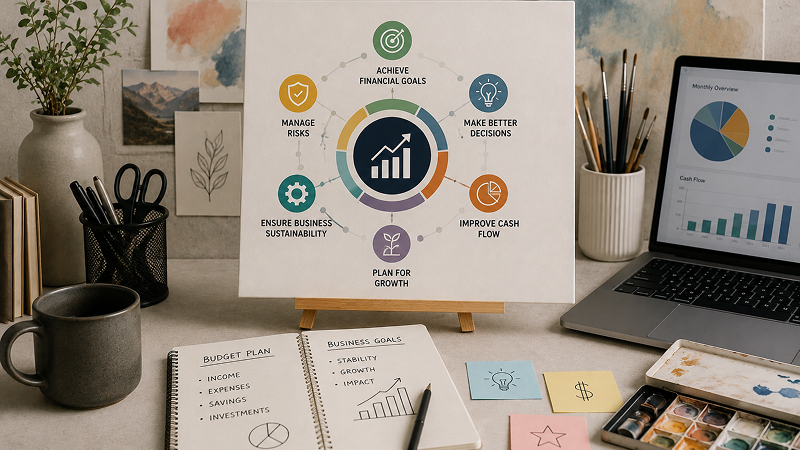
Why Financial Planning Is Crucial for Creative Businesses
1. Revenue Doesn’t Always Mean Profit
One of the biggest mistakes creative entrepreneurs make is focusing only on revenue.
Suppose your creative business generates $100,000 in revenue. That sounds impressive, but after paying freelancers, software costs, advertising, equipment, office expenses, taxes, and other overhead, your actual profit may be much lower.
This is why profitability for creative businesses is more important than simply increasing revenue.
You need to understand:
Revenue − Expenses = Profit
Knowing your profit helps you identify unnecessary costs, improve pricing, and focus on the services that provide the greatest financial return.
2. Cash Flow Keeps Your Business Running
A client might approve a $10,000 project today but not pay the invoice for another 60 days.
Meanwhile, your business still has bills to pay.
This is why cash flow management is essential.
A cash-flow forecast helps you understand:
- When client payments are expected
- When business expenses are due
- How much cash is available
- Whether you can afford new investments
- When a potential cash shortage could occur
A business can be profitable on paper and still experience financial trouble if it doesn’t have enough cash available at the right time.
3. It Helps You Price Your Creative Services Correctly
Pricing is one of the biggest challenges for creative entrepreneurs.
Many people simply look at competitor prices or multiply an hourly rate by the estimated project hours.
But your pricing should consider much more than creative production time.
Include:
- Client meetings
- Research
- Revisions
- Project management
- Software
- Equipment
- Marketing
- Administrative work
- Taxes
- Business overhead
- Desired profit
You can also consider value-based pricing, where the price reflects the value and results your work provides to the client rather than only the number of hours spent.
The right pricing strategy allows you to earn enough to cover expenses while creating healthy profit margins.
4. Financial Planning Prepares You for Slow Periods
Creative businesses often experience unpredictable income.
Instead of assuming every month will be busy, build your finances around realistic revenue expectations.
One of the best strategies is creating a business emergency fund.
Gradually build enough savings to cover several months of essential operating expenses.
This financial cushion can help you handle:
- Slow seasons
- Lost clients
- Delayed payments
- Unexpected equipment repairs
- Temporary revenue declines
Having savings means you don’t have to accept every project simply because you need immediate cash.
5. It Makes Business Growth More Strategic
Growth can be exciting, but it can also increase expenses.
Hiring an employee, purchasing equipment, renting a larger workspace, or increasing your marketing budget can significantly affect your finances.
Before making a major investment, ask:
How much will it cost?
What additional revenue could it generate?
How long will it take to recover the investment?
Can my business afford it if revenue falls?
This is where financial forecasting for small businesses becomes valuable.
Instead of making decisions based purely on excitement, you can use financial data to determine whether an investment makes sense.
6. It Helps You Prepare for Taxes
Tax planning shouldn’t happen only when a deadline is approaching.
Creative entrepreneurs should keep accurate records of income and eligible business expenses throughout the year and set aside appropriate funds for tax obligations.
Because tax rules depend on your location and business structure, professional advice may be useful as your business grows.
The important lesson is simple:
Don’t treat money reserved for taxes as money available to spend.
Proper tax planning can prevent unpleasant surprises and unnecessary financial stress.
7. You Can Identify Your Most Profitable Services and Clients
Not every service or client contributes equally to your bottom line.
For example, a $5,000 project may appear more valuable than a $2,000 project. But if the $5,000 project requires twice as much time, more revisions, and additional resources, the smaller project may actually be more profitable.
That’s why creative businesses should track profitability by service and client.
Ask:
- Which services generate the highest profit margins?
- Which projects consume too much time?
- Which clients pay reliably?
- Which clients require excessive support?
- Which services should be promoted or repriced?
These insights can help you build a more profitable business model.
A Simple Financial Planning Strategy

You don’t need to become an accountant to improve your business finances.
Start with these five steps:
1. Separate Business and Personal Finances
Keep business income and expenses separate from personal finances wherever appropriate. This makes bookkeeping and financial analysis much easier.
2. Track Every Expense
Record software subscriptions, equipment, advertising, contractors, travel, professional fees, and other business expenses.
Small recurring costs can add up quickly.
3. Create a Monthly Budget
Separate fixed expenses from variable expenses and determine how much revenue your business needs each month to operate comfortably.
4. Forecast Your Cash Flow
Look at the next three to twelve months and estimate expected income and expenses.
This can help you identify potential cash shortages before they become emergencies.
5. Set Measurable Financial Goals
Instead of simply saying “increase revenue,” create specific goals such as:
- Increase profit margin by 10%
- Build a six-month emergency reserve
- Increase average project value
- Reduce unnecessary expenses
- Create recurring monthly revenue
Clear goals make financial planning actionable.
Financial Planning Gives Creative Entrepreneurs More Freedom
Financial planning isn’t just about numbers.
It can give you something every creative entrepreneur values: freedom.
When your finances are disorganized, you may feel forced to accept every client, undercharge for your work, or work excessive hours.
But when you have healthy cash flow, profitable pricing, financial reserves, and clear goals, you have more choices.
You can turn down poor-fit clients.
You can invest in better tools.
You can hire support.
You can take creative risks.
You can spend more time doing the work you actually enjoy.
Financial planning doesn’t restrict creativity. It protects it.
Final Thoughts
Building a successful creative business requires more than talent.
You need a strong financial foundation that supports your creativity and allows your business to grow sustainably.
Start by understanding your revenue, expenses, profit, and cash flow. Then improve your pricing, build financial reserves, plan for taxes, and review your finances regularly.
The goal isn’t simply to create a business that makes money.
It’s to create a creative business that is profitable, financially secure, resilient, and built to last.
Your creativity may attract the clients.
Your expertise may deliver the results.
But smart financial planning can help ensure your creative business is still thriving years from now.